This is a Complete and well-written guide to create a winning Lead Generation funnel for your business. Here we have covered what it is. To How to build it?
Attracting and converting potential customers is vital for the sustained growth of any company. Small businesses, in particular, have faced significant challenges due to sudden shifts in customer purchasing behavior. To stay ahead of the game, small businesses need to navigate unexpected shifts in customer buying behavior.
Implementing a well-designed lead generation funnel is key to this process, as it not only captivates visitors but also guides them through their sales journey. So, how can you effectively build and optimize this funnel? In this guide, we’ll explore actionable strategies to help you create a funnel that not only aligns with your business goals but also resonates deeply with your target audience.
Table of contents
- What is a lead generation funnel?
- Stages of the lead generation funnel
- How to build a lead generation funnel?
What is a lead generation funnel?
Lead generation is a strategic process that focuses on attracting potential customers and converting them into qualified leads. This strategic process is designed to navigate your target audience through various stages that ultimately lead to a purchase decision. The process typically unfolds in four key phases: Awareness, Interest, Consideration, and Decision.
Lead generation is about nurturing relationships and guiding potential customers through these stages, ensuring they feel informed and supported until they are ready to commit to a purchase.
Stages of the lead generation funnel
The lead generation funnel generally consists of 3 primary stages,
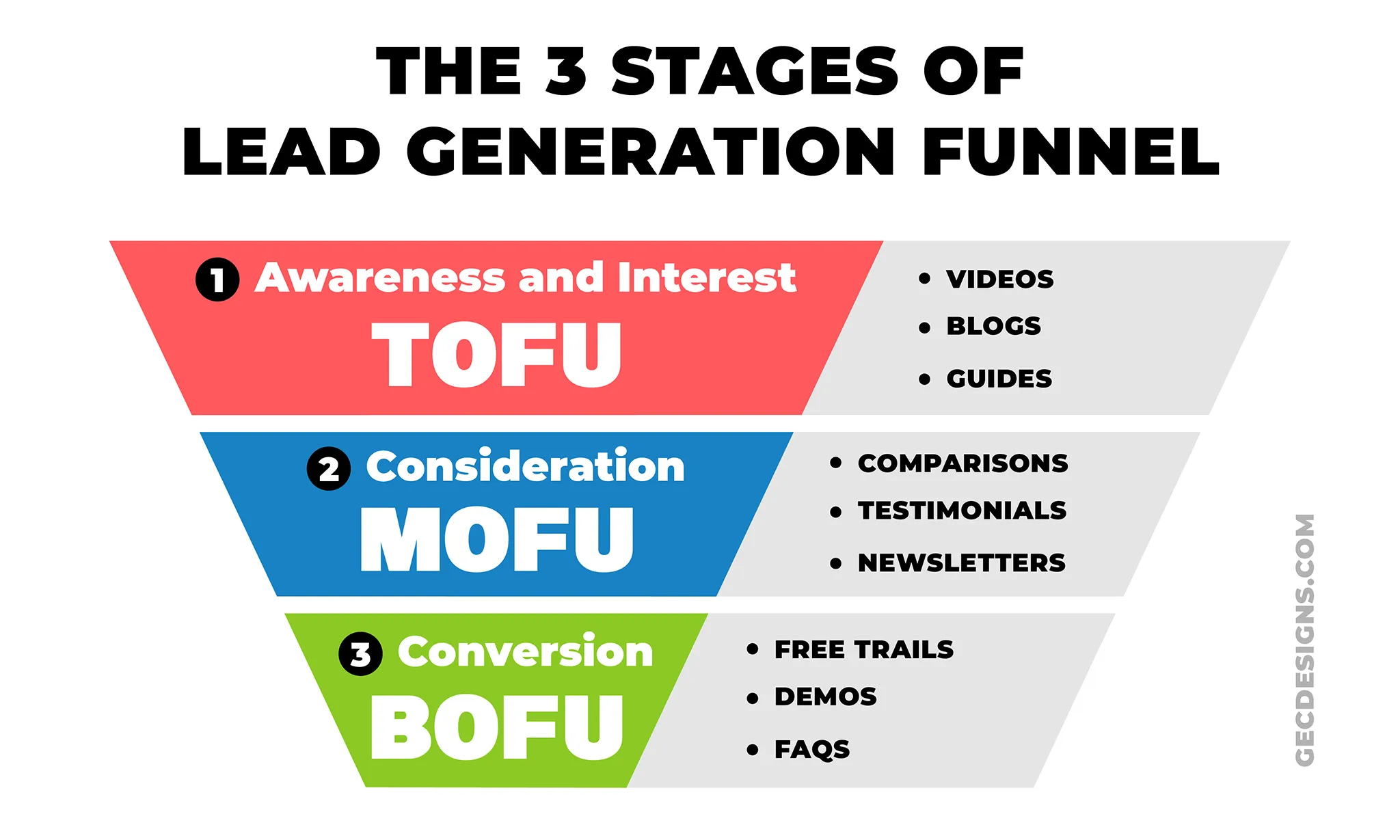
Top of the funnel (TOFU) – Awareness and Interest
In the initial phase of the marketing funnel, referred to as the Top of the Funnel (TOFU), potential customers begin to discover your brand, products, or services through a variety of marketing channels such as social media platforms, content marketing efforts, and paid advertising campaigns. Among the most common forms of content used during this stage are engaging video content, informative blog posts, and targeted email marketing campaigns. The primary objective at this stage is to capture the interest of potential customers and drive traffic to your website or landing page.
Once you have successfully attracted their attention, the next step is to engage these visitors more deeply. To spark their interest during this phase, it’s essential to offer them valuable information and compelling content that aligns with their needs and interests. Here, you can utilize case studies, webinars, and more in-depth blog posts to inform and nurture leads, promoting a stronger connection that encourages them to consider your offerings more seriously.
Middle of the funnel (MOFU) - Consideration
In the Middle of the Funnel (MOFU) stage, the primary objective is to enhance customer engagement. At this point, potential customers are already familiar with your brand, products, or services, but they may not yet be ready to make a purchase decision. Visitors at the MOFU stage are typically exploring all of the options available to solve their problems.
In this critical phase, you should demonstrate to your visitors that your solution not only aligns with their requirements but also effectively addresses their problems. To achieve this, providing more comprehensive and persuasive content is key.
As the audience begins to evaluate their options, offering detailed comparisons between your offerings and those of your competitors becomes essential. This is the right time to showcase testimonials from satisfied customers, present compelling case studies that highlight real-world applications of your product, and deliver in-depth product information that outlines the unique benefits and advantages of choosing your solutions. By providing potential customers with the necessary insights, you can help guide them towards making an informed decision, ultimately positioning your brand as the optimal choice for their needs.
Bottom of the funnel (BOFU) - Conversion
At this final stage of the marketing funnel, known as the Bottom of the Funnel (BOFU), the focus is on persuading potential leads to complete their purchase. By this point, you have already established a relationship with your audience, and now it's crucial to make that final push to convert them into paying clients.
In this significant phase, providing content and experiences that facilitate the decision-making process is key. Examples of effective BOFU content include free trials, personalized demos that showcase the value of your offerings, consultations that address specific concerns, and attractive discount offers that incentivize a purchase.
To enhance your conversion efforts, consider some strategies such as creating a sense of urgency with limited-time offers, conducting personalized follow-ups, and implementing various incentives that motivate them to take the final step and become paying customers.
How to build a lead generation funnel?
- Identify your target audience
- Create compelling content
- Build a landing page with actionable CTAs
- Drive traffic to the lead magnets
- Nurture and send qualified leads to sales
- Analyze and refine the funnel
Identify Your Target Audience
Before you create your funnel, it's essential to identify and understand your target audience. To define your target audience, start by examining who is currently engaging with your product or service. Take a closer look at their demographics, the industries they belong to, and the challenges they encounter. Conduct thorough market research to uncover market trends and competitor strategies.
By crafting detailed buyer personas based on job roles, pain points, and desires, you're speaking directly to the needs of those most likely to benefit from your solution. This customer-centric approach will help you determine your lead generation efforts to attract the right audience.
You can use surveys, pop-ups, or interviews to gather crucial insights.
Consider the following as you build your buyer persona:
- Who are they?
- Is your audience generally younger or older?
- What gender do they identify with, if any?
- What are their interests?
- What are their needs and wants?
- What challenges or problems are they struggling with?
- How do they make their purchasing decision?
Once you identify your target audience, you can get a clear view of how to create an effective lead generation funnel.
Create Compelling Content
After identifying your target audience, the next crucial step is to develop compelling content. Crafting valuable content goes beyond simply filling your website with text; it's about delivering the information, solutions, and inspiration your audience seeks. By producing engaging, high-quality content, you can position yourself as an authority in your industry that will help to create trust and credibility with your audience.
The content you produce may vary in length and type according to your buyer personas, but it should provide effective solutions. To effectively guide customers through the sales funnel, marketers should address their specific needs and obstacles at each phase. It's also essential to deliver content at the right moment and through the right channels where your audience is most active.
Types of content you can use to capture your audience’s attention,
- Blog posts
- Ebooks
- Webinars
- Videos
- Podcasts
- Infographics
- Quizzes
- Social media posts
- Free trials or tools
- Templates
- Guides
- Cases studies
Creating engaging content can enhance your visibility and reach, driving organic traffic to your website and boosting search rankings. This approach allows more potential customers to discover your brand, effectively entering your lead funnel.
Build a Landing page with Actionable CTAs
The landing page serves as the gateway for potential leads entering your marketing funnel. Take time to create an effective landing page. Even if your lead magnet is valuable, but without the right landing page it won’t be successful.
A successful landing page should be a simple and focused layout, with a specific, actionable objective in mind. The ultimate goal is to encourage your visitors to take one desired action, which is crucial for conversion.
Key Elements of a Landing Page
Compelling Headline - Your headlines need to be impactful and direct, capturing attention immediately. They should not only draw visitors in but also convey the core message concisely and enticingly.
Related post – 11 tips to write attractive headlines
Captivating Visuals - The role of images and videos is critical in persuading visitors to take the next step. The right images can evoke the necessary emotions that are actually needed for successful conversions.
Highlight the Benefits - Highlight your Unique Value Proposition (UVP) and explain why it's valuable to your audience. Show your visitors what is unique about your product or service, and that helps you to stand out from your competitors. Use persuasive language to effectively convince your audience why they need what you are providing and how it addresses their specific needs or pain points.
Strong Call to Action (CTA) - Your CTA should be clear and actionable, precisely indicating what you want your visitors to do next. Utilize conversion-focused CTAs such as “Download Now,” “Start Your Free Trial,” or “Claim Your Discount Today” to get immediate responses.
Social Proof - Incorporate elements like testimonials, customer reviews, success stories, and customer brand logos to build credibility and trust with your audience. This validation can significantly influence potential leads by showcasing the satisfaction of existing customers.
Lead Capture Form - Your lead capture form can either appear directly on the landing page or be triggered to appear as a pop-up when a visitor interacts with your CTA. It is important to keep your forms concise and straightforward; avoid requesting excessive information to encourage more visitors to complete them.
By focusing on these key elements, you can create a landing page that not only attracts potential leads but also effectively converts them into valuable customers.
Drive traffic to the Lead Magnets
To effectively fill your lead generation funnel, it’s essential to drive targeted traffic to your landing pages through a variety of channels. Below are some of the most effective strategies to consider for attracting high-quality traffic.
Organic Search - Implementing a strong SEO strategy is a highly effective way to drive traffic to your content. By optimizing your website and content for search engines, you can increase your visibility and attract a large number of visitors at the top of the lead generation funnel. Focus on keyword research, on-page optimization, and quality content creation to rank higher in search results.
Paid Advertising – Use paid advertising to provide a significant boost to your visibility and direct traffic to your content. Consider platforms such as Google Ads, LinkedIn Ads, and Facebook Ads, which are particularly popular for B2B marketing. This strategy allows you to target specific keywords relevant to your products or services, ensuring that your advertisements reach the right audience.
Social Media - Social media platforms act as powerful tools for lead generation, enabling businesses to enhance brand visibility, interact with their target audience, and promote their products or services effectively. By producing and sharing strategic content, you can engage a broader audience and capture the attention of potential leads. If your existing audience is limited, or if you're aiming to extend your reach, consider utilizing social media advertisements to increase traffic to your content.
Related post – How to increase website traffic through Social media?
Email Marketing - Email marketing presents an excellent opportunity to engage with individuals who are already familiar with your brand, products, or services. These subscribers have opted in to receive communications from you, making it easier to encourage them to take action. Personalizing your emails and ensuring that they are relevant to the recipient will help nurture leads effectively and guide them further down the sales funnel.
By leveraging these varied strategies, organic search, paid advertising, social media, and email marketing, you can create a comprehensive approach to driving targeted traffic and filling your lead generation funnel with high-quality potential clients.
Nurture and Send Qualified leads to sales
Establishing a meaningful relationship with your leads requires more than simply collecting their contact information. Once leads enter your marketing funnel, it’s crucial to actively engage with them rather than assuming they will convert on their own. This is the perfect opportunity to nurture these relationships and guide leads to the next stage of the funnel.
Here are several Lead Nurturing strategies you can implement,
Welcome Emails - Utilize personalized welcome emails to introduce your brand and familiarize new leads with your products and the resources you offer. This initial communication sets the tone for future interactions and helps establish a connection.
Educational Email Series - Plan a series of pre-scheduled emails designed to provide ongoing value. This series can include informative content, detailed product information, inspiring success stories, and exclusive offers. By spacing these emails over time, you can keep your brand top of mind while gradually educating your leads.
Social Media Engagement - Actively engage with your leads on social media platforms. This involvement allows you to respond to inquiries, share valuable content, and create discussions that resonate with their interests.
Interactive Sessions - Host live Q&A sessions or webinars around topics that are relevant to your leads. These events not only provide valuable insights but also allow for real-time interaction, promoting a deeper connection with your audience.
Additionally, consider segmenting your leads based on various criteria such as their engagement level, demographics, and readiness to purchase. By categorizing your leads into distinct segments, you can customize your messages to meet the unique needs and challenges of each group, addressing their specific pain points and goals. This targeted approach increases the likelihood of conversion and helps in building lasting relationships.
Analyze and Refine the funnel
Evaluate the effectiveness of your lead generation funnel by thoroughly analyzing its performance to pinpoint both its strengths and possible areas for improvement. It’s crucial to monitor key performance indicators, including website traffic, conversion rates, lead quality, click-through rates, and cost per lead. These metrics will provide insight into how well your lead generation strategies are functioning.
Utilize advanced analytics tools and implement A/B testing to explore various components of your funnel, such as headlines, images, calls to action (CTAs), and email content. Testing these elements will help you determine which variations resonate most with your audience, allowing you to optimize each component for improved results.
By Continuous refining of your lead generation funnel will help you achieve consistent growth and effectively drive your business forward over time.
Conclusion
When it comes to creating a successful lead generation funnel, every stage, from identifying your target audience to effectively nurturing leads, is crucial for overall success. Each step plays a significant role in guiding potential customers through their journey, ultimately leading to conversions. It's important to continuously monitor and evaluate the performance of your funnel at each stage, allowing you to make informed adjustments to your strategies as needed for optimal results.
I hope this article provides valuable insights for developing your lead generation funnel. I encourage you to share your thoughts, questions, or experiences on social media with this article link.