Learn why a digital marketing strategy matters in the AI era and how businesses can use content, data, AI tools, and trust to grow smarter in 2026.
A few years ago, digital marketing felt like an advantage.
If a business had a decent website, posted on social media, sent a few emails, and run some Google or Facebook ads, it could still stand out in many markets.
But 2026 is different.
Today, almost every business has access to powerful tools. A small business owner can use ChatGPT to write blog posts, Canva to design social media graphics, Adobe Express to create branded visuals, Mailchimp or HubSpot to send emails, and Meta Ads Manager or Google Ads to reach customers. Even a solo entrepreneur can create a week’s worth of content in one afternoon.
That sounds exciting.
But it also creates a problem.
When everyone can create content, the internet becomes louder. More posts. More ads. More videos. More emails. More offers. More “expert” opinions. More brands are trying to get attention.
And in that noise, many good businesses quietly disappear.
They are not failing because their product is bad. They are not failing because they are not trying. They are failing because their marketing efforts are scattered. They are posting, advertising, emailing, and creating content without one clear direction.
That is where a digital marketing strategy becomes important.
A strategy helps a business decide what to say, who to say it to, where to show up, how often to communicate, what tools to use, what numbers to track, and how to turn attention into actual business growth.
This is especially important for US small businesses, marketers, startups, service providers, e-commerce brands, and solo entrepreneurs who are competing in crowded markets. The opportunity is big, but the competition is bigger than ever.
HubSpot’s 2026 State of Marketing report says AI is flooding the market with content, and brands without a clear point of view are getting lost. It also highlights that growth is now tied closely to distinctiveness, trust, and relevance.
That is the heart of this article.
Digital marketing is no longer just about being online.
It is about being found, remembered, trusted, and chosen.
Explore Digital Marketing Strategy Topics
Choose a topic below to understand why a digital marketing strategy matters in the AI era.
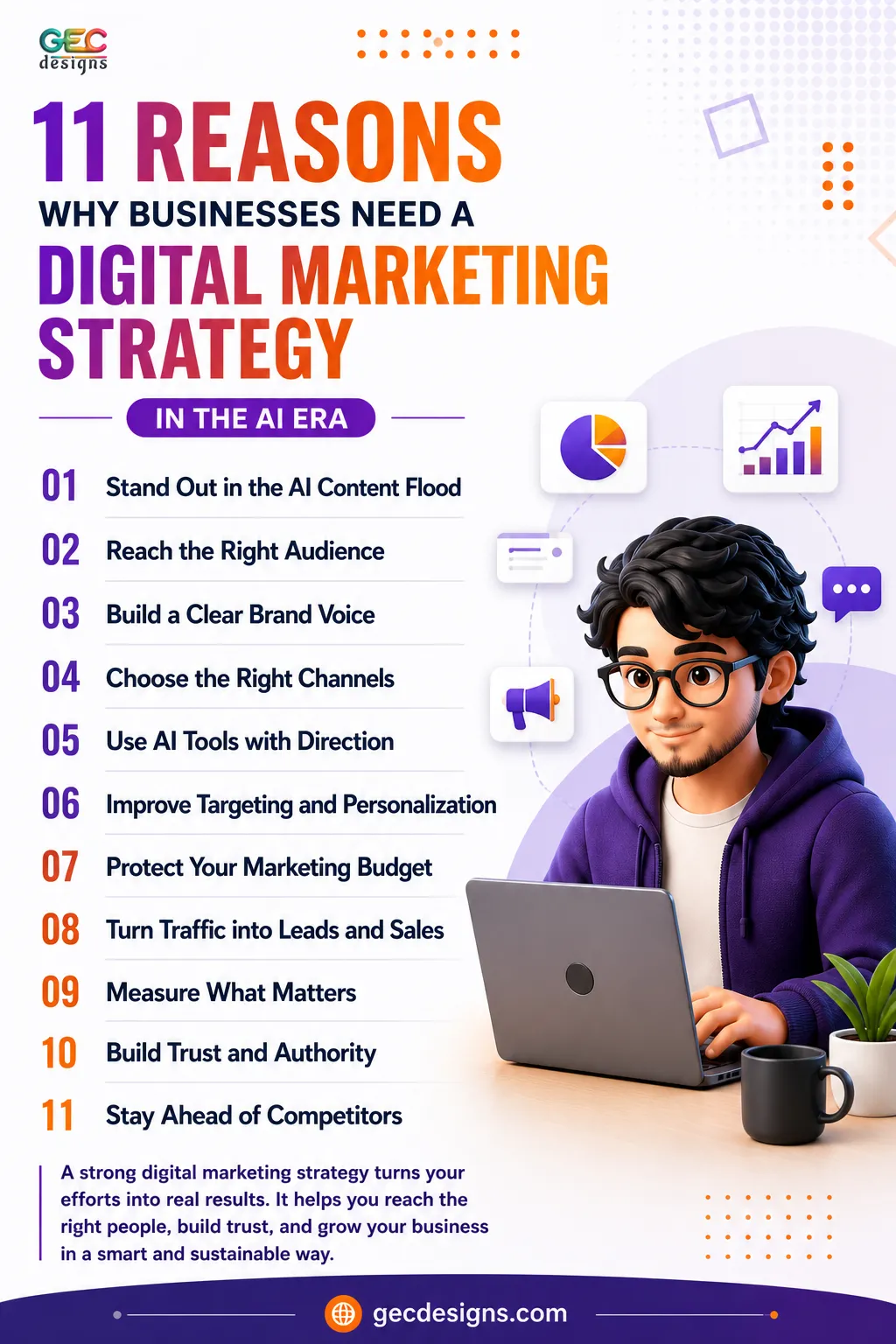
11 Reasons Why Businesses Need a Digital Marketing Strategy in the AI Era
1. A Digital Marketing Strategy Helps You Stand Out in the AI Content Flood
Not long ago, content creation was slow.
A business had to hire a writer, designer, video editor, social media manager, or agency to create consistent marketing content. That naturally limited how much content entered the market.
Now, AI has changed that completely.
A business owner can generate blog ideas in seconds. A marketer can create ad copy, email subject lines, LinkedIn posts, product descriptions, YouTube scripts, Instagram captions, and landing page drafts using AI tools. Design platforms like Canva and Adobe Express make it easier to create visuals. Tools like Jasper, ChatGPT, HubSpot AI, and other content assistants help teams produce more material with less effort.
This is useful.
But it also means your customers are seeing more content than ever before.
Their inbox is full. Their social feeds are full. Their search results are full. Their YouTube recommendations are full. Their attention is being pulled in every direction.
So, the question is no longer:
“Can we create content?”
The better question is:
“Can we create content that has a purpose, speaks to the right person, and helps the business grow?”
That is where strategy makes the difference.
Without a strategy, AI can help you produce more content, but not necessarily better marketing. You may end up publishing five posts a week that do not connect to your customers’ real problems. You may create videos that look nice, but do not support your sales funnel. You may write blog posts that drive traffic, but do not generate qualified leads.
A digital marketing strategy gives every piece of content a role.
- One blog post may be designed to attract people searching for a problem.
- One video may be created to build trust.
- One email may be written to bring back a warm lead.
- One ad may be used to test a new offer.
- One case study may help a buyer make a final decision.
This is the difference between content activity and content direction.
I have seen this pattern many times with small businesses. A business owner starts posting because someone told them, “You need to be active online.” So they post tips, quotes, offers, product photos, behind-the-scenes updates, and random AI-generated captions.
After a few months, they feel tired.
They say, “We are posting, but nothing is happening.”
Usually, the problem is not effort. The problem is that the content is not connected to a strategy.
A strong strategy answers simple but powerful questions:
- Who exactly are we trying to reach?
- What problem are they trying to solve?
- What do they need to believe before they buy from us?
- Which channels do they trust most?
- What type of content helps them move forward?
- What action do we want them to take next?
Once these questions are clear, AI becomes more useful. It becomes an assistant, not the driver. It helps you create faster, but your strategy decides what should be created in the first place.
This matters even more because the use of AI in marketing is becoming commonplace. HubSpot’s 2026 marketing statistics report says about 94% of marketers plan to use AI in their content creation processes, including blog articles, in 2026.
That means AI-generated content is not rare anymore.
It is the new baseline.
So, if every competitor is using similar tools, your advantage cannot come only from using AI. Your advantage must come from better thinking, clearer positioning, stronger customer understanding, and more consistent execution.
That is exactly what a digital marketing strategy gives you.
Key Highlights
- AI has made content creation easier, but it has also made the market noisier.
- More content does not automatically mean more leads or sales.
- A digital marketing strategy gives every post, ad, email, and video a clear purpose.
- AI tools work best when they support a strategy instead of replacing one.
2. It Helps You Reach the Right Audience, Not Just More People
One of the biggest mistakes businesses make is thinking that digital marketing is only about reach.
- More impressions.
- More followers.
- More website visitors.
- More views.
- More clicks.
These numbers can feel exciting, especially when a campaign starts getting attention. But attention alone does not pay the bills.
A local accounting firm in Texas does not need traffic from everyone in the country. It needs small business owners, contractors, consultants, and professionals who need tax planning, bookkeeping, payroll, or financial guidance.
A B2B software company does not need random social media likes. It needs decision-makers, operations leaders, founders, or department heads who have a real business problem and a budget.
A boutique fitness studio in Chicago does not need thousands of views from people who will never visit. It needs residents who care about fitness, convenience, community, and results.
This is why strategy matters.
A digital marketing strategy helps businesses move from broad visibility to meaningful visibility.
It helps answer:
- Who is our best customer?
- Where do they spend time online?
- What problem are they actively trying to solve?
- What search terms do they use?
- What social platforms influence them?
- What kind of proof do they need?
- What offer will make them take action?
When these answers are clear, the business can stop chasing everyone and start speaking to the right people.
This is especially important in the US market because competition is intense across almost every industry. Whether you are in home services, healthcare, ecommerce, SaaS, real estate, legal services, education, coaching, consulting, or local retail, your potential customers are comparing options before they make a decision.
- They may search on Google.
- They may check reviews.
- They may ask ChatGPT or another AI search assistant for suggestions.
- They may watch YouTube videos.
- They may compare brands on TikTok, Instagram, LinkedIn, Reddit, or review platforms.
- They may click an ad today but not buy for weeks.
Without a strategy, your business may show up in random places but miss the actual buying journey.
With strategy, every channel has a purpose.
For example:
- SEO helps you get discovered when people search for answers.
- Google Ads helps you appear when people show buying intent.
- LinkedIn helps B2B brands build authority and relationships.
- Instagram and TikTok help visual brands create an emotional connection.
- Email marketing helps you nurture leads over time.
- Retargeting ads help bring back people who already showed interest.
- Google Business Profile helps local customers find and trust you.
A digital marketing strategy connects these channels instead of treating them as separate activities.
This is where many businesses lose money. They run ads without a landing page strategy. They post on social media without a lead capture system. They publish blogs without internal links, calls to action, or email follow-up. They collect leads but do not nurture them. They get traffic but do not understand what visitors actually need.
A strategy fixes this by creating a path.
The customer should not feel like they are jumping from one disconnected message to another. They should feel guided.
That guidance can look simple:
- A customer searches for a problem on Google.
- They find your blog post.
- The blog post explains the issue clearly.
- They download a checklist or request a consultation.
- They receive a helpful email sequence.
- They see a retargeting ad with a case study.
- They book a call or make a purchase.
That is not luck.
That is a strategy.
And it is becoming more important because digital ad spending continues to rise. EMARKETER reported that US total media ad spending was projected to reach $422 billion in 2025 under its best-case scenario, showing how competitive the advertising environment has become.
When more businesses are spending to get attention, a strategy helps you avoid paying for the wrong audience.
Reaching more people may look good on a report.
Reaching the right people is what grows the business.
Key Highlights
- Big reach is not useful if it does not attract the right audience.
- A digital marketing strategy helps define who the business should target and where to reach them.
- US businesses need focused visibility because customers compare many options before buying.
- The goal is not just traffic; the goal is qualified attention that can become revenue.
3. It Gives Your Brand a Clear Voice and Point of View
In the AI era, generic content is everywhere.
- You can see it in blog posts that all sound the same.
- You can see it in LinkedIn captions that feel polished but empty.
- You can see it in product descriptions that say the right words but create no emotion.
- You can see it in ads that promise “growth,” “results,” “solutions,” and “innovation,” but never explain why the brand is different.
This is one of the biggest hidden dangers of modern digital marketing.
AI can help businesses create content faster, but if every business uses the same prompts, same formats, same templates, and same safe language, their marketing starts to blend.
Customers may see the content, but they do not remember the brand.
That is why a digital marketing strategy must include brand voice and point of view.
Your brand voice is how your business sounds.
Your point of view is what your business believes.
For example, two companies may sell the same service, but their positioning can be completely different.
One marketing agency may say:
“We help businesses grow online.”
Another may say:
“We help small businesses stop wasting money on random marketing and build simple systems that turn attention into leads.”
The second one is clearer. It has a point of view. It speaks to a real pain. It feels more human.
This matters because customers are not only buying products and services. They are buying confidence. They want to feel, “This business understands me.”
In 2026, trust is a major marketing advantage.
HubSpot’s 2026 State of Marketing report says that as AI floods the market with content, brands without a clear point of view are getting lost, and growth is increasingly driven by distinctiveness, trust, and relevance.
Deloitte Digital’s 2026 marketing trends also note that generative AI has reached a point where it can produce customer-facing work, which means marketers need systems where human creativity and machine intelligence work together.
That last part is important.
The future of digital marketing is not humans versus AI.
It is a human strategy plus AI support.
Your strategy should tell AI what your brand stands for, what tone to use, what topics matter, what customer pains to address, what promises to avoid, and what kind of trust you want to build.
For example, a financial advisor’s brand voice may need to feel calm, responsible, and educational.
A fitness brand may need to feel energetic, supportive, and motivating.
A law firm may need to sound clear, confident, and trustworthy.
A SaaS company may need to sound practical, smart, and focused on solving business problems.
A local bakery may need to sound warm, personal, and community-driven.
Without a strategy, your content may sound different every week. One post may sound formal. Another may sound playful. One email may push too hard. Another may feel it is too vague. One ad may attract bargain hunters, while another tries to attract premium buyers.
That confuses customers.
A clear digital marketing strategy keeps your voice consistent across every channel:
- Website
- Blog
- Social media
- Email campaigns
- Paid ads
- Landing pages
- Videos
- Case studies
- Sales materials
- Customer support messages
Consistency builds memory.
And memory builds trust.
One useful exercise for businesses is to create a simple brand voice guide before producing content at scale.
It can include:
- What we believe
- Who we help
- What problems do we solve
- Words we use often
- Words we avoid
- How do we explain our value
- How we want customers to feel
- What makes our approach different
- What proof do we use to support our claims
This kind of guide may seem simple, but it can prevent a lot of weak marketing.
It also makes AI tools much more effective. Instead of asking an AI tool to “write a social media post,” the business can give it direction, like below,
- Write for small business owners in the US.
- Use a helpful and honest tone.
- Avoid hype.
- Focus on the pain of wasted ad spend.
- Explain why strategy matters before scaling content.
- End with a soft call to action.
Now the output becomes more relevant because the strategy is clearer.
In my experience, this is where many businesses start to feel a real shift. They stop asking, “What should we post today?” and start asking, “What does our audience need to understand before they trust us?”
That one question can change everything.
Because marketing is not only about being visible.
It is about being meaningful.
Key Highlights
- AI can create content quickly, but strategy gives the content personality and direction.
- A clear brand voice helps customers remember and trust your business.
- Your point of view explains what your business believes and why it is different.
- Consistent messaging across channels makes your marketing feel stronger and more professional.
4. It Helps You Choose the Right Digital Marketing Channels
One of the easiest mistakes businesses make in digital marketing is trying to be everywhere.
They started a Facebook page because everyone has one. Then they open an Instagram account because their competitors are posting reels. Then someone tells them to try TikTok. Another person says LinkedIn is better. Then they hear SEO is important. Then they start a newsletter. Then they run Google Ads for two weeks. After that, they test Meta Ads, YouTube Shorts, influencer marketing, and maybe even a podcast.
At first, it feels productive. The business is active. The team is busy. Content is going out.
But after a few months, the owner looks at the results and asks a painful question:
“Why are we doing so much, but getting so little?”
This is where a digital marketing strategy becomes a filter. It helps the business decide which channels actually matter and which channels are only creating noise.
Not every business needs to be on every platform. A local roofing company in Ohio may get better results from local SEO, Google Business Profile, customer reviews, Google Ads, and before-and-after project photos than from posting daily on TikTok. A B2B software company may need LinkedIn, webinars, search-optimized comparison pages, email nurturing, and case studies. A DTC skincare brand may need Instagram, TikTok, influencer marketing, email, SMS, product reviews, and paid social ads.
The right channel depends on the customer, the offer, the sales cycle, the budget, and the type of trust the buyer needs before making a decision.
For example, if someone is searching “emergency plumber near me,” they are not casually browsing. They need help now. In that case, Google Search, local SEO, Google Business Profile, and strong reviews matter more than inspirational social media content. But if someone is choosing a business coach, interior designer, fitness program, or high-ticket software solution, the decision may take longer. They may need educational content, social proof, email follow-up, testimonials, webinars, and comparison pages before they are ready to buy.
A strategy helps connect the channel to the buyer’s mindset.
That is important because attention is becoming more expensive. US ad spending continues to grow, and E-MARKETER reported that US ad spending growth is expected to accelerate in 2026 as AI-fueled gains in social and retail media reshape the market.
In simple terms, more businesses are spending more money to get in front of the same customers. Without a clear channel strategy, it becomes easy to waste budget in places where your best customers are not paying attention.
A good digital marketing strategy usually starts by grouping channels into roles. Some channels are for discovery. Some are for trust-building. Some are for conversion. Some are for retention.
- Some channels are for discovery.
- Some channels are for trust-building.
- Some channels are for conversion.
- Some channels are for retention.
For example, SEO may help people discover your business when they search for answers. Social media may help them understand your personality and values. Email marketing may help you build a relationship over time. Paid ads may help you reach people faster. Retargeting may bring back visitors who were interested but not ready. CRM tools may help your sales team follow up with leads before they go cold.
- SEO may help people discover your business when they search for answers.
- Social media may help them understand your personality and values.
- Email marketing may help you build a relationship over time.
- Paid ads may help you reach people faster.
- Retargeting may bring back visitors who were interested but not ready.
- CRM tools may help your sales team follow up with leads before they go cold.
When each channel has a role, marketing becomes easier to manage.
This also helps businesses avoid a common trap: judging every channel by the same metric. A LinkedIn post may not generate direct sales immediately, but it may build authority with decision-makers. A blog post may not convert on the first visit, but it may attract high-intent search traffic for months. An email sequence may not bring new visitors, but it may turn warm leads into paying customers. A short-form video may not close a deal, but it may make the brand more familiar.
Strategy teaches you what each channel is supposed to do.
In one common small-business scenario, the owner says, “Instagram is not working for us.” But when you look closer, Instagram was never connected to a clear offer, landing page, lead magnet, or follow-up process. The channel was not the only problem. The real issue was that Instagram was being used as a posting board, not as part of a customer journey.
That is the bigger lesson.
Digital marketing channels are not magic. They are tools. And tools only work when you know what job they are supposed to do.
Key Highlights
- A business does not need to be on every digital platform.
- The best channels depend on the customer, offer, budget, and buying journey.
- A digital marketing strategy helps each channel play a clear role.
- Without a strategy, businesses often confuse activity with progress.
5. It Makes AI Tools Useful Instead of Overwhelming
AI tools have opened up incredible opportunities for businesses. A small team can now do things that once required a bigger budget, more people, or an outside agency. They can brainstorm content ideas, create campaign drafts, design graphics, write email sequences, analyze customer feedback, summarize research, build outlines, and even generate video scripts.
That is powerful.
But it can also become overwhelming.
Many businesses now have too many tools and not enough direction. They use ChatGPT for content, Canva for design, Adobe Express for visuals, Jasper for marketing copy, HubSpot AI for CRM and campaigns, Mailchimp for email, Google Analytics 4 for tracking, Semrush or Ahrefs for SEO research, Zapier or Make for automation, and Meta Ads Manager or Google Ads for campaigns.
Each tool can help. But without a strategy, the business may simply create more scattered work.
This is one of the biggest changes in digital marketing in the AI era. In the past, businesses struggled because content creation was slow. Now, many businesses struggle because content creation is too easy. The barrier has moved from production to direction.
A digital marketing strategy gives AI tools a clear job.
Instead of asking, “What can we create today?” the business starts asking, “What does our customer need to understand next?”
That question changes how AI is used.
For example, a business can use ChatGPT to turn customer questions into blog outlines. It can use Canva or Adobe Express to turn the main points into social graphics. It can use HubSpot or Mailchimp to build an email sequence that sends the same educational message to leads. It can use Google Analytics 4 to see which topics bring qualified visitors. It can use Semrush or Ahrefs to understand search demand. It can use Zapier or Make to connect lead forms with CRM follow-up.
- A business can use ChatGPT to turn customer questions into blog outlines.
- It can use Canva or Adobe Express to turn the main points into social graphics.
- It can use HubSpot or Mailchimp to build an email sequence that sends the same educational message to leads.
- It can use Google Analytics 4 to see which topics bring qualified visitors.
- It can use Semrush or Ahrefs to understand search demand.
- It can use Zapier or Make to connect lead forms with CRM follow-up.
Now the tools are not separate toys. They are part of a system.
This is where the real value of AI comes in. AI should help businesses move faster, but it should not make the brand careless. It should reduce repetitive work, not remove human thinking. Deloitte Digital’s 2026 marketing trends explain that AI is reducing the cost of content production and making hyper-personalized communication easier, but it also depends on real-time data, strong systems, and clear commercial models.
That point matters for business owners.
AI alone is not a strategy. AI is an accelerator. If your strategy is clear, AI helps you move faster in the right direction. If your strategy is weak, AI helps you create confusion faster.
Imagine two businesses using the same AI tool.
The first business says, “Write us five social media posts about our service.” The tool creates five generic posts. They sound fine, but they could belong to anyone.
The second business says, “Write five LinkedIn posts for US small business owners who are wasting money on ads without a landing page strategy. Use a helpful tone, explain one mistake per post, and invite them to download our checklist.”
The second output will be stronger because the strategy is stronger.
The tool did not magically become better. The direction became better.
This is why businesses should create simple internal rules before using AI at scale. They should define their audience, brand voice, offer, proof points, content pillars, approval process, and measurement goals. This prevents the marketing from becoming random or inconsistent.
- Audience
- Brand voice
- Offer
- Proof points
- Content pillars
- Approval process
- Measurement goals
A practical AI-supported marketing workflow may look like this:
- First, identify the customer problem.
- Then, research keywords, competitor content, and customer questions.
- Next, use AI to draft ideas or outlines.
- After that, add human insight, examples, proof, and brand voice.
- Then create supporting assets for social, email, and ads.
- Finally, measure the results and improve the next version.
That is a healthy way to use AI.
It keeps the human brain in charge.
In 2026, the winning businesses will not be the ones using the most AI tools. They will be the ones using AI with the clearest business strategy.
Key Highlights
- AI tools can speed up marketing, but they cannot replace direction.
- Without a strategy, AI may produce more generic content and scattered campaigns.
- Tools like ChatGPT, Canva, Adobe Express, HubSpot AI, Jasper, GA4, Semrush, Ahrefs, Zapier, and Make work better when connected to one clear plan.
- The best use of AI is to support human strategy, not replace it.
6. It Improves Targeting and Personalization
Customers do not want to feel like they are part of a random audience list. They want messages that feel relevant to their needs, timing, location, budget, and stage of decision-making.
This does not mean every message has to feel overly customized or invasive. It simply means businesses need to stop speaking to every customer the same way.
A first-time website visitor needs a different message than someone who has already requested a quote. A past customer needs a different message than a cold lead. A small business owner comparing software options needs a different message than an enterprise buyer. A homeowner researching ideas needs a different message than someone ready to book a service this week.
A digital marketing strategy helps businesses understand these differences and communicate with more care.
This is where targeting and personalization become important.
In older marketing, a business often created one message and pushed it everywhere. In modern digital marketing, the better approach is to segment the audience and match the message to the situation.
For example, an ecommerce brand may create different email flows for first-time visitors, cart abandoners, repeat customers, VIP buyers, and inactive customers. A local service business may create different campaigns for emergency needs, seasonal maintenance, and long-term planning. A B2B company may create content for founders, managers, finance teams, and technical decision-makers because each group cares about different benefits.
This is not just a technical task. It is a customer understanding task.
AI and data tools make personalization easier, but the strategy decides what personalization should mean. HubSpot’s 2026 State of Marketing highlights how marketers are using AI, brand point of view, and human-led systems to drive trust, efficiency, and growth. That is the right balance: use data and AI, but keep the communication human.
Businesses can use tools like HubSpot, Salesforce, Klaviyo, Mailchimp, ActiveCampaign, Google Analytics 4, Meta Ads Manager, LinkedIn Campaign Manager, and customer data platforms to understand behavior and create better audience segments. But again, tools are only useful when the business knows what it is trying to learn.
A simple segmentation strategy may include:
- New visitors who need education.
- Warm leads who need proof.
- Price-sensitive buyers who need comparison.
- High-value buyers who need confidence.
- Past customers who need retention.
- Inactive customers who need re-engagement.
Each group deserves a different message.
Let’s take a practical example. A small home remodeling company in the US may attract different types of visitors. Some people are searching for “kitchen remodel ideas.” They are early in the journey and need inspiration, cost ranges, and planning tips. Others search “kitchen remodeling contractor near me.” They are closer to hiring and need reviews, project photos, financing options, and a quote request.
If the company sends both groups to the same generic page, it may lose both.
But with a strategy, the company can create educational content for early-stage visitors and conversion-focused pages for ready-to-hire prospects. It can retarget visitors with project galleries, send email guides, and show testimonials based on the service they viewed.
That is personalization with purpose.
The same idea works for many industries. A dentist can separate routine cleaning campaigns from cosmetic treatment campaigns. A SaaS company can separate free-trial users from enterprise demo requests. A consultant can separate startup founders from established business owners. A fitness brand can separate beginners from advanced athletes.
The goal is not to make marketing complicated. The goal is to make it more relevant.
Because relevance builds trust.
And trust improves conversion.
Key Highlights
- Customers respond better when messages match their needs and stage of decision-making.
- A digital marketing strategy helps businesses segment audiences instead of treating everyone the same.
- AI and CRM tools can support personalization, but the strategy must define the purpose.
- Better targeting usually leads to better engagement, stronger leads, and more efficient spending.