What if artificial intelligence stopped improving tomorrow? Explore how work, creativity, expectations, and our relationship with AI would change.
Artificial intelligence is usually described as something that’s always speeding up things, with smarter models, new tools, and bigger expectations. Every update feels like a step closer to something revolutionary, and many of us quietly assume that improvement is guaranteed.
But let’s pause and sit with a different idea for a moment.
What if AI stopped improving tomorrow?
Not slowed down. Not regulated differently. Not replaced.
Just… frozen exactly where it is today.
This isn’t a prediction. It’s a thought experiment. And when you really think it through, it reveals something important, not just about AI, but about us.
Freezing AI at Its Current State
If AI development stopped tomorrow, nothing would suddenly disappear. Writing assistants would still help draft emails. Image generators would still create visuals. Recommendation systems would still decide what you see online. Translation tools would still bridge languages.
Everything would work exactly as it does right now.
At first, that might not sound dramatic at all. In fact, for many people, it could feel like relief. No more racing to keep up with updates. No more wondering if today’s tool will be obsolete next month. No more “you must learn this new AI feature” posts flooding your feed.
I’ve seen this feeling firsthand. With one client, we paused experimenting with new tools for three months and focused only on mastering what they already had. Their stress dropped, productivity went up, and the work finally felt manageable again.
Sometimes stability feels more valuable than progress.
Key highlights:
- Existing AI tools would keep functioning normally
- The overwhelm of constant updates would fade
- Stability could bring clarity instead of chaos
How Workflows Would Settle
Right now, many teams build workflows that are temporary by default. “This will be better soon” becomes an excuse to avoid deep optimization. But if improvement stopped, that mindset would have to change.
People would stop chasing the next tool and start asking better questions:
- How do we actually use this well?
- Where does it help, and where does it fail?
- What should humans handle instead?
Workflows would become calmer and more intentional. Instead of constant experimentation, there would be refinement. Instead of novelty, familiarity.
In my experience, this is where real efficiency lives. When tools stop changing, people finally learn them deeply, and that’s when results improve.
Key highlights:
- Teams would optimize instead of constantly switching tools
- AI would feel more predictable and reliable
- Mastery would replace experimentation
The Shift in Expectations
A lot of today’s tolerance for AI flaws comes from hope. People accept errors because they believe better versions are coming soon. But if progress stopped, expectations would reset.
Users would become more honest and more critical.
Limitations that were easy to ignore would stand out clearly. AI wouldn’t be treated as a “future solution” anymore, but as a fixed tool, like a spreadsheet, a camera, or a piece of software that simply has boundaries.
This shift could actually be healthy. When expectations align with reality, frustration decreases. AI wouldn’t be blamed for not being human, and humans wouldn’t expect it to be magic.
Key highlights:
- Users would judge AI based on reality, not promises
- Limitations would be more visible and better understood
- AI would feel like a tool, not a replacement for thinking
The Impact on Creativity
AI is often called a creative partner, but much of that excitement comes from surprise. New styles. New capabilities. New tricks. If AI stopped evolving, that surprise would fade.
Creators would quickly learn its patterns. The outputs would feel familiar. And that’s where something interesting would happen: human creativity would matter more again. Writers would need stronger ideas. Designers would rely more on taste and direction. Musicians would use AI as a starting point, not the final voice.
I’ve noticed this with creative teams already. The most compelling work doesn’t come from asking, “What can the tool do?” but from asking, “What do I want to say?”
Key highlights:
- AI-generated novelty would fade faster
- Human intention would become more important
- Creativity would shift from surprise to meaning
Businesses Would Rethink Their Strategies
Many business plans today are built on future AI improvements. “Once the model gets better…” is a common phrase.
If improvement stopped, those plans would need revision.
Instead of waiting for better tools, companies would invest in better usage. Training would matter more than tech upgrades. Strategy would matter more than features. I’ve worked with teams that got better results from teaching employees how to think alongside AI rather than adding new software. Progress came from understanding, not innovation.
Key highlights:
- Business strategies would become more grounded
- Training and process would matter more than upgrades
- Growth would come from skill, not hype
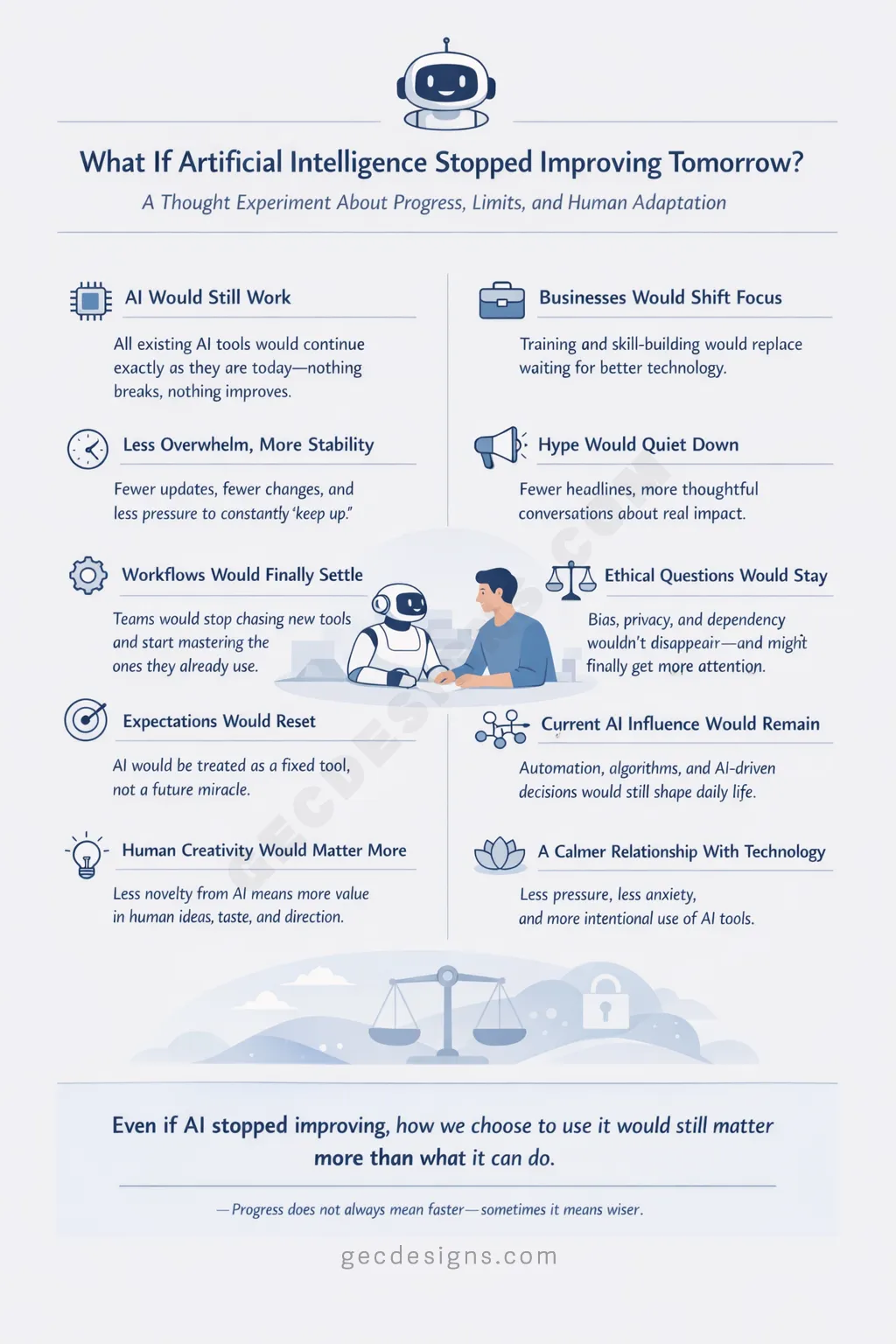
The Research and Hype Cycle Would Quiet Down
Without breakthroughs, headlines would slow. The noise would fade. And in that quiet, reflection would grow.
Instead of asking “What’s next?”, people would ask “What has actually changed?” Conversations would shift from speculation to observation. From excitement to evaluation. This slower pace could lead to better decisions, especially in education, policy, and long-term planning.
Key highlights:
- Less hype, more reflection
- Focus on real-world outcomes
- Deeper understanding instead of constant reaction
Ethical and Social Questions Would Remain
Even without progress, ethical questions wouldn’t disappear. Bias, privacy, dependency, and fairness would still exist.
In fact, they might finally get the attention they deserve.
Without new features stealing focus, society could examine current impacts more carefully. Regulation could become clearer. Guidelines could become more practical. Sometimes, slowing down is what allows responsibility to catch up.
Key highlights:
- Ethical issues would still matter deeply
- Slower change could support better regulation
- Focus would shift from reaction to responsibility
What Would Not Change
Many fears about AI are rooted in imagined futures. If progress stopped, those extreme scenarios would fade. But the present reality would remain.
AI would still influence work. Algorithms would still shape attention. Automation would still affect jobs. None of that disappears just because improvement pauses. The impact we already live with would still need thoughtful management.
Key highlights:
- Current AI influence would continue
- Job and attention shifts would still exist
- Present challenges would still require action
A Different Relationship With Technology
Perhaps the biggest change wouldn’t be technical at all, it would be emotional. AI would stop feeling like a race. People wouldn’t feel behind for not keeping up. Technology would feel more stable, less demanding. And that stability could bring something rare in modern tech: peace.
When tools stop changing, people finally have space to think about how they want to use them, not how fast they need to adapt.
Key highlights:
- Less pressure to constantly adapt
- A calmer relationship with technology
- More focus on intention than speed
A Thought Worth Sitting With
This thought experiment isn’t about hoping AI stops or fearing that it will. It’s about noticing how much of today’s conversation depends on the assumption of constant improvement.
When you imagine a pause, you see something clearly: progress isn’t just about what technology does next. It’s about how people respond, adapt, and choose to use what already exists.
Whether AI keeps advancing or not, our relationship with it matters just as much as its capabilities.Sometimes, the most meaningful progress doesn’t come from moving forward faster, but from understanding where we already are, and deciding what kind of future we actually want to build.
Conclusion
Imagining a world where AI stops improving tomorrow isn’t about predicting failure or celebrating limits. It’s about perspective.
This thought experiment quietly reminds us that much of our anxiety, excitement, and urgency around AI isn’t driven by what it is today, but by what we assume it will become. When that future is taken off the table, even hypothetically, something changes. We stop looking ahead and start looking around.
We notice how deeply AI is already woven into our work, creativity, and daily routines. We see where it genuinely helps and where it quietly falls short. And most importantly, we’re forced to acknowledge something we often forget: technology doesn’t define progress on its own, people do.
If AI froze tomorrow, we would still need judgment, creativity, ethics, empathy, and responsibility. We would still need humans to decide how tools are used, where boundaries should exist, and what really matters. Mastery would matter more than upgrades. Intention would matter more than speed.
There’s a quiet lesson here worth holding onto, even if AI never stops improving. Progress doesn’t always mean moving faster. Sometimes it means pausing long enough to understand what we already have, how it’s shaping us, and whether it’s serving the life and society we actually want.
Whether AI accelerates or stalls, the real work remains the same: learning how to live wisely with powerful tools, without letting them rush us past ourselves.