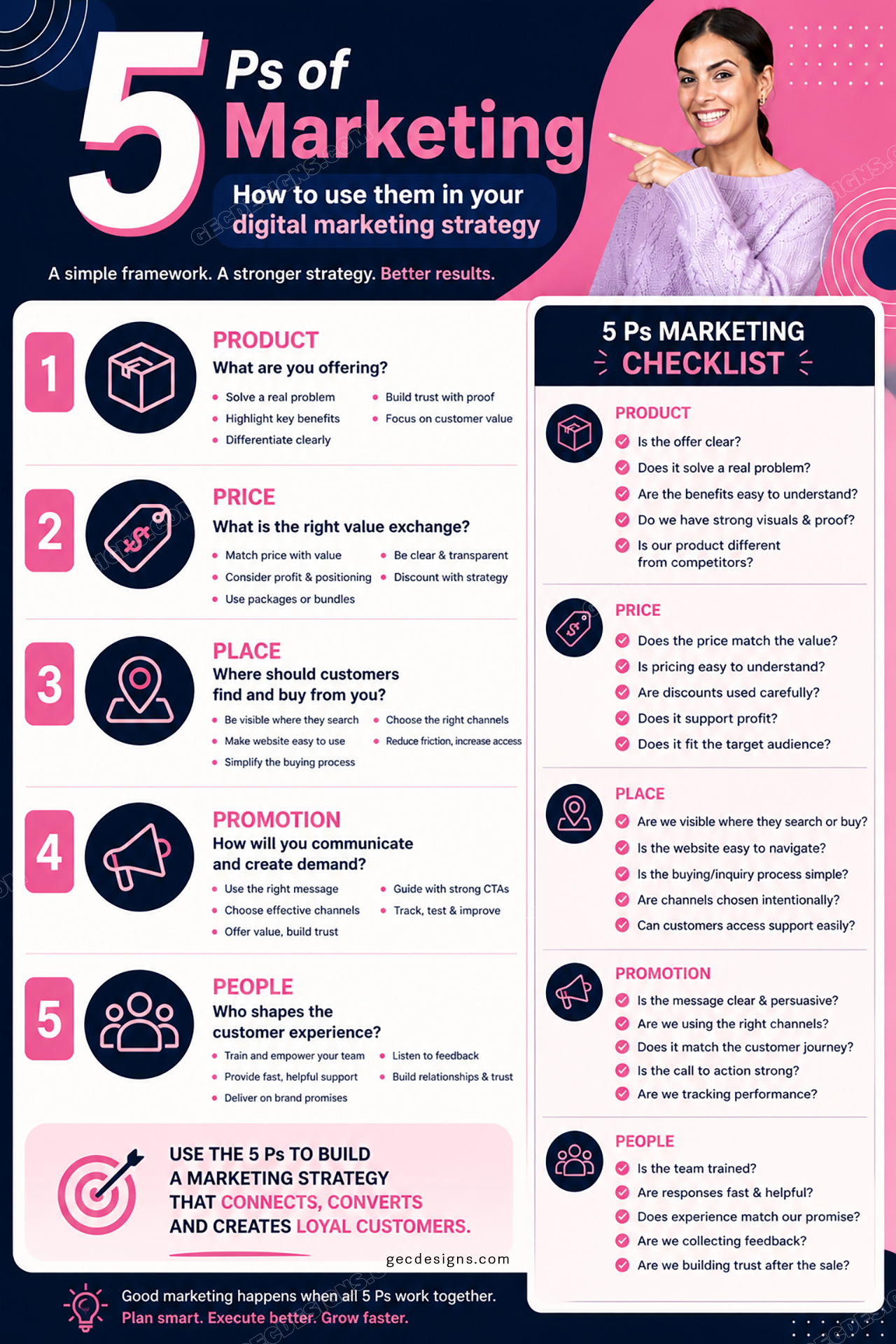
Learn what the 5 Ps of marketing are and how to use product, price, place, promotion, and people to build a smarter digital marketing strategy.
Marketing often feels complicated because there are so many moving parts.
You have to think about your website, social media, ads, SEO, email campaigns, pricing, customer experience, content, competitors, and now even AI tools. It is easy for a business to feel busy every day and still wonder, “Why are we not getting the results we expected?”
Most of the time, the problem is not effort.
The problem is alignment.
A business may have a good product but poor promotion. Another may have strong ads but the wrong price. Some businesses attract visitors to their website, but the customer experience is weak. Others create a lot of content, but the message does not clearly explain why people should choose them.
This is where the 5 Ps of marketing become useful.
The 5 Ps give marketers and business owners a simple way to look at the bigger picture. They help you understand what you are offering, how much it should cost, where customers can find it, how you should promote it, and who is responsible for creating a good customer experience.
The 5 Ps are:
- Product
- Price
- Place
- Promotion
- People
These five elements are not just old marketing theory. They are still highly relevant in today’s digital marketing world. In fact, they may be even more important now because customers have more choices, more information, and more control than ever before.
In this article, we will break down each of the 5 Ps of marketing in simple terms and explain how you can use them to build a stronger digital marketing strategy.
Article Index
Explore each section of the 5 Ps of marketing and how they support a stronger digital marketing strategy.
What Are the 5 Ps of Marketing?
The 5 Ps of marketing is a marketing mix framework that helps businesses plan, position, and promote their products or services more effectively.
Think of them as five key questions every business should answer before launching a campaign, building a website, running ads, or trying to attract customers online.
When these five elements work together, your marketing feels clear and focused. When one of them is weak, the whole strategy can suffer.
For example, you can have an excellent product, but if your pricing feels confusing, customers may hesitate. You can have strong paid ads, but if your website is difficult to use, people may leave without buying. You can create beautiful content, but if it reaches the wrong audience, it may not generate leads.
That is why the 5 Ps are so practical.
They help you step back and ask, “Is our marketing system working as a whole?”
Why the 5 Ps Still Matter in Digital Marketing
Digital marketing has changed a lot.
Businesses now use websites, landing pages, SEO, Google Ads, Meta Ads, Instagram, TikTok, LinkedIn, YouTube, email automation, CRM tools, influencer marketing, AI writing tools, analytics dashboards, and customer data platforms.
But even with all these tools, the basic marketing questions remain the same.
- What are you selling?
- Who is it for?
- Why should they care?
- Where will they find it?
- How much should they pay?
- What message will convince them?
- Who will support them before and after the sale?
That is exactly what the 5 Ps help you answer.
In digital marketing, tools can make your work faster, but they do not automatically make your strategy better. A business can run ads every day and still fail if the offer is unclear. It can post on social media consistently and still struggle if the product does not solve a real problem. It can use AI to create content quickly, but if the message does not match the customer’s needs, the content will not convert.
The 5 Ps bring discipline to your digital marketing strategy.
They make sure your marketing is not just active, but intentional.
A helpful way to think about it is this:
The 5 Ps help you connect your product, customer, message, channel, and experience into one clear marketing system.
That is what most businesses need. Not more random activity, but better alignment.
1. Product: What Are You Really Offering?
The first P in the marketing mix is Product.
A product is what your business offers to customers. It can be a physical product, a digital product, a mobile app, a service, a course, a subscription, a consultation, or even a complete customer experience.
But in marketing, “product” does not only mean the item itself.
It includes everything around the offer:
- Features
- Benefits
- Design
- Quality
- Branding
- Packaging
- User experience
- Warranty
- Customer support
- Product description
- Visual presentation
- After-sales service
In simple words, your product is not just what you sell. It is what the customer believes they are getting from you.
For example, a customer buying a fitness program is not only buying videos or workout plans. They may be buying confidence, discipline, better health, and a feeling of control over their life.
A customer buying a website design service is not only buying pages and layouts. They may be buying credibility, business growth, better first impressions, and more leads.
A customer buying a premium phone is not only buying hardware. They may be buying design, status, simplicity, ecosystem, and trust.
This is why marketers need to understand the product deeply before promoting it.
If you do not know what problem your product solves, your marketing message will feel weak. If you do not know what customers value most, you may highlight the wrong features. If you do not know how your product is different from competitors, your campaigns may sound generic.
Product in Digital Marketing
In a digital marketing strategy, your product must be clearly explained across every customer touchpoint.
That includes:
- Website homepage
- Product pages
- Service pages
- Landing pages
- Social media posts
- Ad copy
- Email campaigns
- Blog content
- Product images
- Videos
- Testimonials
- FAQs
Your customer should not have to work hard to understand what you offer.
A strong product page, for example, should explain what the product is, who it is for, what problem it solves, how it works, why it is different, and what the customer should do next.
This is where many businesses lose conversions. They talk about features, but not benefits. They describe what the product does, but not why it matters. They show images, but not enough proof. They write long descriptions, but the customer still does not feel confident.
A good product message should make the customer feel:
“This is exactly what I need.”
Questions to Ask About Your Product
Before promoting your product or service, ask:
- Who is the target audience?
- What problem does this product solve?
- What does the customer truly want?
- What features matter most?
- What benefits should we highlight?
- How does this product improve the customer’s life or business?
- What makes it different from competitors?
- What proof can we show?
- What objections might customers have?
- What support or guarantee do they need?
These questions help you create a stronger product message.
Product Example
Imagine a small business selling eco-friendly water bottles online.
A weak product message may say:
“Our bottles are durable and available in many colors.”
A stronger product message may say:
“Stay hydrated all day with a reusable bottle designed to keep drinks cold, reduce plastic waste, and fit easily into your daily routine.”
The second version speaks to lifestyle, values, and practical use. It gives the product more meaning.
That is the power of understanding the first P.
Key Takeaway
Your product is not just what you sell. It is the value, experience, and solution your customer believes they are receiving.
2. Price: What Is the Right Value Exchange?
The second P is Price.
Price is the amount customers pay for your product or service. But pricing is not only about numbers. It also affects how customers perceive your brand.
A low price may attract more buyers, but it can also make people question quality. A high price may create a premium image, but it can also reduce demand if customers do not understand the value. Discounts may increase sales, but too many discounts can train customers to wait and never buy at full price.
This is why pricing needs a strategy.
A good pricing decision considers:
- Product value
- Production cost
- Profit margin
- Customer willingness to pay
- Competitor pricing
- Market demand
- Brand positioning
- Seasonal offers
- Payment options
- Discounts
- Bundles
- Subscription models
- Perceived quality
Pricing has a strong psychological effect on buying behavior.
Customers do not always choose the cheapest option. They often choose the option that feels like the best value.
That is an important difference.
A customer may pay more if they trust the brand, understand the benefit, see strong reviews, get better support, or believe the product will save time, reduce stress, or produce better results.
Price in Digital Marketing
In digital marketing, pricing shows up in many places.
It appears on your product pages, service pages, pricing tables, ads, email offers, landing pages, checkout pages, and sales calls. If the price is not presented clearly, customers may hesitate.
A pricing page should not simply show numbers. It should help customers understand the value behind the price.
For example, if you offer a service package, explain what is included, who it is best for, what outcome it supports, and why that package is worth the investment.
If you offer multiple pricing plans, make the comparison easy. Customers should quickly understand the difference between basic, standard, and premium options.
If you offer discounts, use them carefully. A discount should feel like an opportunity, not a warning sign that the original price was too high.
Common Pricing Mistakes
Many businesses make pricing decisions based only on competitors. They look at what others charge and then try to be cheaper.
That can be dangerous.
If your only advantage is a lower price, you may attract price-sensitive customers who leave as soon as someone else becomes cheaper.
A better approach is to understand your value.
Ask yourself:
- Are we faster?
- Are we easier to use?
- Do we offer better support?
- Do we have stronger expertise?
- Do we save customers more time?
- Do we reduce risk?
- Do we provide a better experience?
- Do we offer better design, quality, or convenience?
If yes, your pricing should reflect that value.
Questions to Ask About Price
Before deciding your pricing strategy, ask:
- Does the price match the quality and value of the product?
- Does the price support our profit margin?
- What are competitors charging?
- What price feels too high for our audience?
- What price feels too low and may reduce trust?
- What does our customer consider valuable?
- Should we offer monthly, yearly, or one-time pricing?
- Should we use bundles or packages?
- When should we offer discounts?
- How will pricing affect brand perception?
These questions help you avoid random pricing decisions.
Price Example
A SaaS company may offer three pricing plans:
- Starter for small teams
- Growth for growing businesses
- Enterprise for larger organizations
This structure helps customers choose based on their needs. It also allows the company to serve different market segments without confusing everyone with one fixed price.
For service businesses, pricing can also be packaged. Instead of saying “contact us for pricing” everywhere, the business can show starting prices, package ranges, or “best for” descriptions to help customers understand what to expect.
Key Takeaway
Price is not only what customers pay. It is part of how they judge your value, quality, trust, and brand position.
3. Place: Where Should Customers Find and Buy From You?
The third P is Place.
Place refers to where and how customers find, access, and buy your product or service.
In traditional marketing, place often meant physical stores, distributors, retail locations, or trade shows. In digital marketing, place has become much broader.
Today, a place can include:
- Your website
- E-commerce store
- Google search
- Google Business Profile
- Social media platforms
- Online marketplaces
- Mobile apps
- Email links
- Landing pages
- YouTube
- Affiliate websites
- Local directories
- Third-party platforms
- Physical store locations
Place is about convenience and accessibility.
Your customers should be able to find you where they naturally search, browse, compare, and buy.
For example, if your target audience searches on Google before buying, SEO and Google Ads may be important. If they discover products through Instagram or TikTok, visual content and social commerce may matter. If they compare options on Amazon, Etsy, or other marketplaces, your marketplace presence may be important. If you serve a local area, your Google Business Profile, reviews, maps visibility, and location pages can be critical.
A strong place strategy answers one simple question:
“Where does our customer prefer to make this decision?”
Place in Digital Marketing
In digital marketing, choosing the right place means choosing the right channels.
Not every business needs every platform.
A B2B consulting company may not need to focus heavily on TikTok. It may get better results from LinkedIn, SEO, webinars, email marketing, and case studies.
A local restaurant may need a Google Business Profile, Instagram, reviews, local SEO, and delivery platform visibility.
An e-commerce fashion brand may need Instagram, Pinterest, TikTok, email marketing, influencer partnerships, and an easy mobile shopping experience.
A software company may need search content, comparison pages, YouTube demos, review platforms, and retargeting ads.
The right place depends on the audience and the buying journey.
Accessibility Matters
Place is not only about where you appear. It is also about how easy it is for customers to take action.
If you have a website, it should be easy to navigate. If you sell products online, checkout should be smooth. If customers need to call you, your phone number should be easy to find. If they need directions, your location should be accurate. If they want support, they should know where to go.
Many businesses lose customers because the path is not clear.
A customer may be interested, but if the website loads slowly, the form is too long, the product page is confusing, or the checkout process feels risky, they may leave.
The place should reduce friction.
Questions to Ask About a Place
To choose the right place, ask:
- Where does our target audience spend time online?
- How do customers usually search for this product or service?
- Do they prefer buying from a website, marketplace, app, or physical location?
- Which social media platforms influence their decisions?
- Do we need a local search presence?
- Is our website easy to use?
- Is our checkout or inquiry process simple?
- Do customers need customer support before buying?
- Should we sell through third-party marketplaces?
- Are we visible at the right stage of the customer journey?
These questions help you choose channels with purpose.
Place Example
A local dental clinic may not need a complex national marketing campaign. Its place strategy may focus on:
- Google Business Profile
- Local SEO
- Service pages
- Patient reviews
- Location-based ads
- Easy appointment booking
- Mobile-friendly website
For that business, being visible locally is more valuable than getting random traffic from everywhere.
Key Takeaway
Place is about being available where your customers are already looking and making it easy for them to take the next step.
The fourth P is Promotion.
Promotion includes all the ways your business communicates with customers, builds awareness, creates interest, and encourages people to take action.
This includes:
- SEO
- Content marketing
- Email marketing
- Social media marketing
- Paid ads
- Influencer marketing
- Referral programs
- Promotional offers
- Video marketing
- Blog articles
- Google Business Profile posts
- Webinars
- Events
- PR
- Word-of-mouth
- Retargeting campaigns
- Sales funnels
Promotion is often the most visible part of marketing. It is what people usually think about first when they say, “We need marketing.”
But promotion works best only when the other Ps are clear.
If your product is unclear, promotion becomes difficult. If your price does not match the value, the promotion may attract clicks but not sales. If your place is weak, promotion may send people to a confusing website. If your people are not trained, promotion may bring leads that are not handled well.
That is why promotion should not stand alone.
It should connect with the whole marketing mix.
Promotion in Digital Marketing
In digital marketing, promotion is about getting the right message in front of the right people at the right time.
Different audiences need different messages.
- A first-time visitor may need education.
- A warm lead may need proof.
- A returning customer may need a special offer.
- A comparison shopper may need a case study.
- A local buyer may need reviews and location details.
Your promotional strategy should match the customer’s stage.
For example, blog content and SEO may attract people who are researching. Paid search ads may capture people who are ready to buy. Social media may build familiarity. Email marketing may nurture leads. Retargeting ads may remind interested visitors to return.
Strong promotion is not only about visibility. It is about persuasion.
Your message should clearly explain:
- What problem do you solve
- Who you help
- Why your solution matters
- What makes you different
- What proof supports your claim
- What the customer should do next
The Role of Storytelling
Promotion becomes more powerful when it uses storytelling.
Customers do not always connect with technical details first. They connect with problems, emotions, outcomes, and relatable situations.
For example, instead of saying:
“Our software improves workflow efficiency.”
A better promotional message may say:
“Stop losing hours to manual tasks. Our software helps your team manage work faster, reduce errors, and focus on what matters.”
The second message feels more human because it speaks to a real frustration.
Visuals and Messaging
Your promotional content should also pay attention to:
- Colors
- Typography
- Images
- Videos
- Headlines
- Call-to-action buttons
- Landing page layout
- Ad creative
- Brand tone
- Emotional appeal
Small details can influence how customers feel.
A weak headline can reduce clicks. A confusing landing page can reduce conversions. A poor image can make a product feel less valuable. A vague call to action can make people unsure what to do next.
Promotion is not just about saying something. It is about saying it clearly, attractively, and at the right moment.
Questions to Ask About Promotion
Before promoting your product or service, ask:
- Which marketing channels are best for our audience?
- What message will connect with them?
- What problem should we lead with?
- What proof should we show?
- What is the best time to reach them?
- Which offer is most persuasive?
- Is the product seasonal?
- What are competitors promoting?
- Are competitor offers affecting our strategy?
- What call to action should we use?
- How will we measure campaign success?
These questions help you create focused campaigns instead of random promotions.
Promotion Example
A home cleaning service may promote itself through:
- Local SEO
- Google Ads
- Before-and-after images
- Customer reviews
- Seasonal deep-cleaning offers
- Email reminders
- Referral discounts
- Social media posts showing real cleaning results
Each channel supports the same message: a cleaner, easier, more comfortable home.
That is how promotion becomes stronger.
Key Takeaway
Promotion is not just advertising. It is the way your business communicates value, builds trust, and guides customers toward action.
5. People: Who Shapes the Customer Experience?
The fifth P is People.
At first, many businesses think “people” means only customers. But in the marketing mix, people include everyone who affects the customer experience.
That includes:
- Employees
- Sales teams
- Customer support teams
- Marketing teams
- Product teams
- Delivery staff
- Managers
- Leadership
- Partners
- Contractors
- Customer service representatives
- Anyone who communicates with customers
People are one of the most important parts of marketing because customers do not only judge your product. They judge the entire experience around your product.
A great ad may bring a customer in, but a poor support experience can push them away. A beautiful website may create interest, but an unhelpful sales call can lose the deal. A good product may win a first purchase, but a caring support team can create repeat customers and referrals.
People turn marketing promises into real experiences.
People in Digital Marketing
In digital marketing, people influence many touchpoints.
- They respond to comments on social media.
- They answer emails.
- They handle live chat.
- They follow up with leads.
- They write content.
- They manage reviews.
- They solve complaints.
- They onboard customers.
- They represent the brand voice.
This is why training matters.
Your team should understand the product, the brand message, customer pain points, common objections, and the kind of experience your business wants to create.
If your marketing says, “We are friendly and helpful,” but your customer support feels cold and slow, the brand promise breaks.
If your ads say, “Fast response,” but leads wait three days for a reply, trust is damaged.
If your website says, “Premium service,” but the sales process feels careless, customers may not believe the claim.
People create consistency.
Customer Experience as Marketing
In today’s digital marketplace, customer experience itself becomes marketing.
Happy customers leave reviews.
They recommend your business.
They share their experience.
They come back.
They trust your future offers.
Unhappy customers also speak. They may leave negative reviews, complain publicly, or quietly choose a competitor.
This is why people are not separate from marketing. They are part of marketing.
A business with excellent people can create a strong competitive advantage even in a crowded market.
Questions to Ask About People
To strengthen this part of the marketing mix, ask:
- Who interacts with customers directly?
- Are they trained properly?
- Do they understand our product and brand promise?
- How fast do we respond to inquiries?
- How do we handle complaints?
- Does our team understand customer pain points?
- Are sales and marketing aligned?
- Do customers feel supported after purchase?
- Are we collecting and using customer feedback?
- What kind of experience do we want people to remember?
These questions help you improve the human side of marketing.
People Example
A small ecommerce store may sell handmade products. The product may attract the first purchase, but the people behind the brand can create loyalty through:
- Friendly email responses
- Personal thank-you notes
- Fast issue resolution
- Honest communication
- Helpful product guidance
- Caring packaging details
- Warm social media interaction
These human touches make customers feel connected.
Key Takeaway
People are the bridge between your marketing promise and the customer’s real experience.
How AI Is Changing the 5 Ps of Marketing
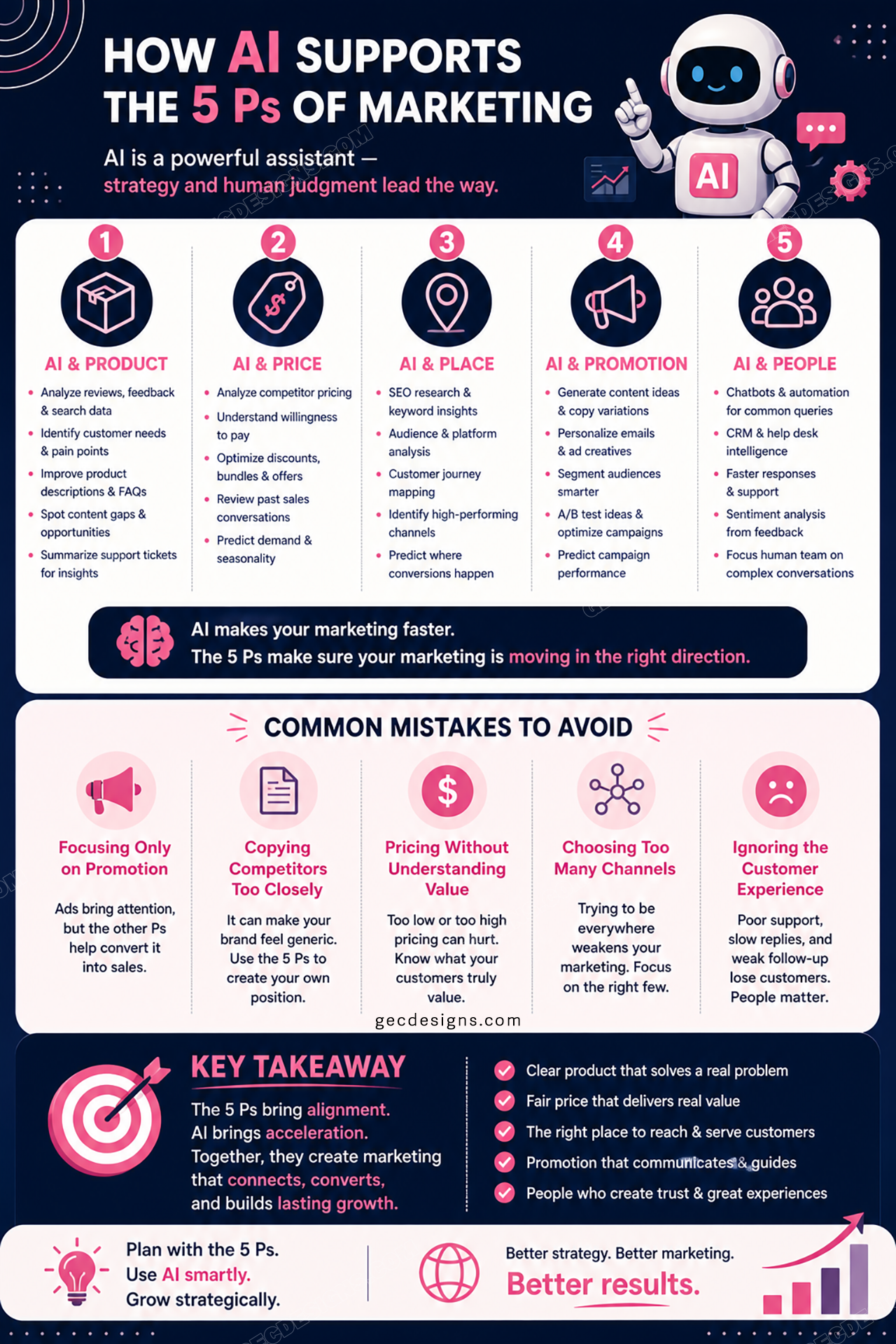
AI is changing digital marketing quickly, but it does not replace the 5 Ps. Instead, it can help marketers apply the 5 Ps with more speed, data, and personalization.
The important thing is to use AI as a support system, not as a replacement for strategy.
AI can help you create content, analyze customer behavior, compare competitors, write product descriptions, generate ad ideas, segment audiences, automate emails, and improve customer support. But it still needs human direction.
A business must still know its audience, offer, values, pricing position, customer experience, and brand voice.
Here is how AI can support each P.
AI and Product
AI can help businesses understand what customers want by analyzing reviews, search queries, customer feedback, support tickets, and competitor content.
For example, if many customers complain that a product is hard to use, AI tools can help summarize that feedback and reveal common patterns. Marketers can then improve product messaging, FAQs, onboarding, or even product features.
AI can also help create better product descriptions, compare feature benefits, and identify content gaps on product pages.
But the final product decision should still come from human understanding.
AI can tell you what customers are saying. Your team must decide what to build, improve, or communicate.
AI and Price
AI can support pricing decisions by helping analyze competitor prices, customer segments, purchase behavior, seasonal demand, and promotional performance.
For e-commerce businesses, AI-powered tools can help identify which products perform better with bundles, discounts, or personalized offers.
For service businesses, AI can help review past sales conversations or lead quality to understand what customers value before they pay.
Still, pricing should not be fully mechanical. Brand position, trust, customer perception, and long-term profitability all matter.
AI and Place
AI can help marketers understand where customers discover and interact with the brand.
It can support SEO research, audience analysis, platform selection, and customer journey mapping. AI-powered analytics tools can show which channels bring traffic, which channels bring qualified leads, and where customers drop off.
This helps businesses avoid spreading themselves too thin across every platform.
Instead of asking, “Where should we post today?” marketers can ask, “Where are our best customers actually engaging and converting?”
AI and Promotion
Promotion is one of the most common areas where marketers use AI.
AI can help with:
- Blog outlines
- Social media captions
- Email subject lines
- Ad copy variations
- Landing page ideas
- Video scripts
- Campaign concepts
- A/B testing ideas
- Personalization
- Customer segmentation
This can save time. But it can also create generic marketing if used without a clear strategy.
The best results happen when AI is given strong direction: target audience, brand voice, customer pain point, product benefit, offer, and call to action.
AI can create faster, but your strategy should decide what is worth creating.
AI and People
AI can also support customer experience.
Chatbots, CRM automation, help desk tools, and AI-assisted support systems can help businesses respond faster and manage repetitive questions.
But people still matter.
Customers want speed, but they also want empathy. They want answers, but they also want to feel heard. AI can support the process, but human care builds deeper trust.
A good approach is to let AI handle simple and repetitive tasks while your team focuses on complex questions, emotional situations, and relationship-building.
A Simple Reminder About AI
AI can make your marketing faster. The 5 Ps make sure your marketing is moving in the right direction.
That is the balance modern marketers need.
How to Use the 5 Ps in Your Digital Marketing Strategy
Understanding the 5 Ps is useful. But applying them is where the real value begins.
Before launching your next campaign, website update, ad strategy, or product promotion, use the 5 Ps as a planning checklist.
Here is a simple step-by-step approach.
Step 1: Start with the Product
Clarify exactly what you are offering and why it matters.
Ask:
- What problem does this solve?
- Who needs it most?
- What benefits should we highlight?
- What makes it different?
- What proof do we have?
Your product message should be clear before you create ads or content.
Step 2: Review the Price
Make sure your price supports both customer trust and business profit.
Ask:
- Does the price match the value?
- Is our pricing clear?
- Do we need packages, bundles, or subscriptions?
- Are discounts helping or hurting our brand?
- Can customers easily understand what they get?
Good pricing removes hesitation.
Step 3: Choose the Right Place
Decide where customers should discover, compare, and buy.
Ask:
- Should we focus on search, social, marketplaces, or local visibility?
- Is our website easy to use?
- Can customers take action quickly?
- Are we present where our audience already spends time?
A strong place strategy makes buying easier.
Step 4: Build the Promotion Plan
Choose the right message and channels.
Ask:
- What content will attract attention?
- What message will create trust?
- Which channels should we use?
- What offer should we promote?
- What action should customers take next?
Promotion should guide people, not just interrupt them.
Step 5: Strengthen the People Side
Make sure the customer experience supports the marketing promise.
Ask:
- Is our team ready to handle leads?
- Are support responses helpful?
- Is our brand voice consistent?
- Are customers getting a good experience after purchase?
- Are we learning from feedback?
People turn marketing into trust.
Quick 5 Ps Marketing Checklist
Use this checklist before launching your next digital marketing campaign.
Product
- Is the offer clear?
- Does it solve a real customer problem?
- Are the benefits easy to understand?
- Do we have strong visuals and proof?
- Is our product different from competitors?
Price
- Does the price match the value?
- Is the pricing easy to understand?
- Are discounts used carefully?
- Does the price support profit?
- Does the price fit the target audience?
Place
- Are we visible where customers search or buy?
- Is the website easy to navigate?
- Is the buying or inquiry process simple?
- Are our digital channels chosen intentionally?
- Can customers access support easily?
Promotion
- Is the message clear and persuasive?
- Are we using the right channels?
- Does the campaign match the customer journey?
- Is the call to action strong?
- Are we tracking campaign performance?
People
- Is the team trained?
- Are customer responses fast and helpful?
- Does the experience match the brand promise?
- Are we collecting customer feedback?
- Are we creating trust after the sale?
This checklist can help you find weak points before they become expensive marketing problems.
Common Mistakes Businesses Make with the 5 Ps
Even when businesses understand the 5 Ps, they may still apply them unevenly.
Here are a few common mistakes to avoid.
Focusing Only on Promotion
Many businesses think marketing means only advertising. They spend money on campaigns without fixing the product message, pricing, website experience, or customer support.
Promotion can bring attention, but the other Ps help convert that attention into sales.
Copying Competitors Too Closely
Competitor research is helpful, but copying competitors can make your brand feel generic.
The 5 Ps should help you define your own position, not simply imitate someone else.
Pricing Without Understanding Value
Some businesses price too low because they are afraid customers will not buy. Others price too high without explaining the value clearly.
Both can create problems.
Good pricing requires customer understanding.
Choosing Too Many Channels
Trying to be everywhere can weaken your marketing. It is better to choose a few channels that match your audience and use them well.
Ignoring the Customer Experience
A business may attract leads through marketing but lose them through slow replies, poor support, confusing processes, or weak follow-up.
People matter.
The customer experience must support the promise your marketing makes.
Conclusion
The 5 Ps of marketing are simple, but they are powerful.
They remind us that good marketing is not built from one campaign, one social media post, one discount, or one advertisement. It comes from alignment. Your product must solve a real problem. Your price must feel fair and valuable. Your place must make it easy for customers to find and buy from you. Your promotion must communicate clearly. Your people must create a customer experience that builds trust.
That is why the 5 Ps are still useful in modern digital marketing. Even in the AI era, where tools can create content, automate emails, analyze data, and support campaigns, businesses still need clear thinking. AI can help you move faster, but the 5 Ps help you move with purpose.
If you want to improve your digital marketing strategy, start by reviewing these five areas. You may find that one small improvement, such as clearer product messaging, better pricing structure, a smoother website experience, stronger promotional content, or faster customer support, can make your entire marketing system work better.
Marketing becomes easier when every part supports the same goal.
The 5 Ps help you build that kind of strategy.